

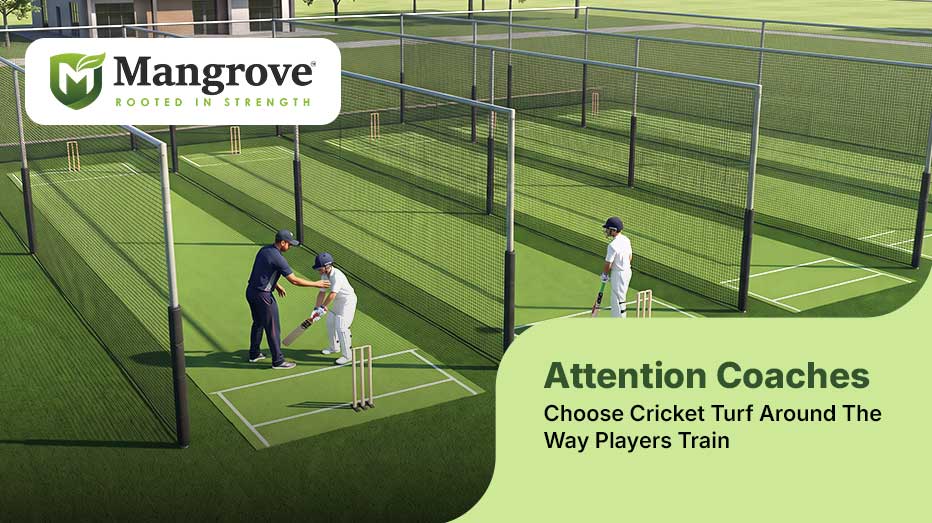
Not every cricket training session has the same objective. A young player learning basic batting technique, a fast bowler working on rhythm and run-up, and an academy conducting intensive coaching with different demands on a training surface.
That is why choosing cricket turf should begin with the training requirement rather than simply selecting a surface based on appearance or price. The right turf can make a practice facility more consistent, durable and better suited to the way coaches intend to use it.
Start with the training programme
It all starts with a simple question: what is the purpose of this turf?
A facility primarily focused on batting drills may have different surface requirements from one designed for intensive bowling practice or all-round player development. Coaches and facility managers should consider the frequency of sessions, number of players, intensity of movement and whether the surface will support individual practice, group coaching or both. Understanding these factors helps determine the appropriate turf specifications and installation approach.
Consider intensity in usage
A cricket academy running several batches every day places substantially different demands on its turf compared with a school using a practice area a few times a week. High-use facilities should pay closer attention to durability, yarn quality, density, pile characteristics and backing construction. These factors influence how the turf responds to repeated foot traffic and regular sporting activity.
Mangrove’s sports turf is positioned for demanding sports applications, with its manufacturing process covering yarn extrusion, tufting, backing application, coating, finishing and quality inspection. The company also states that its products can be customized according to project requirements.
Surface and facility must be compatible with each other
The surrounding environment matters too. An outdoor cricket academy has different requirements from an indoor training centre or a school sports facility. Exposure to sunlight, weather, usage patterns, maintenance practices and installation conditions should all be considered before finalizing a turf specification. UV-stabilized materials can be particularly relevant for outdoor applications, while the overall turf construction needs to suit the expected level of usage. For facility developers and contractors, this is where working with a manufacturer can be more useful than treating turf as a standard off-the-shelf product.
Think beyond the playing surface
A cricket practice facility is rarely just about the turf. Nets, surrounding safety arrangements and the overall layout contribute to how effectively the facility can be used. Mangrove offers sports turf alongside high-strength HDPE net solutions, creating an opportunity for academies, schools, clubs and sports contractors to consider multiple elements of the practice environment through one product portfolio.
Specification should serve performance
Coaches do not necessarily need the most expensive turf. They need turf that corresponds to the actual training requirement. Pile height, density, color, material, backing and other specifications can be evaluated according to the intensity and nature of use. Mangrove states that its turf solutions can be customized in areas including pile height, color and density, allowing project requirements to guide the specification.
This approach can also help sports infrastructure buyers make more informed decisions. Instead of selecting a surface first and adapting the training program later, the turf can be specified around how the facility is expected to operate.
Build the right training environment
The best cricket practice surface is ultimately one that supports the coaching objective, withstands the expected workload and fits the facility’s operational requirements. For coaches, academies, schools, sports contractors and facility developers, Mangrove offers a broader sports-surface proposition combining artificial turf manufacturing, customization, quality inspection and net solutions. With the right specification, turf becomes more than a playing surface—it becomes a foundation for structured, repeatable and dependable cricket training.
